Kids Bhagavatam
 Light of Godhead
The taste I received of Srimad Bhagavatam during our Bhakti-Vaibhava studies under HG Radha Krishna dasa (TKG) from Houston was kindling my desire to share the Srimad Bhagavatam with our twin boys somehow. For few years I kept this desire in the core of my heart not knowing how to teach the boys in a formal way given they were very young (< 5 years).
Finally when the boys turned five, Prahlad maharaja’s instruction given in SB 7.6.1, kept coming to my mind often:
śrī-prahrāda uvāca
kaumāra ācaret prājño
dharmān bhāgavatān iha
durlabham mānuṣam janma
tad apy adhruvam arthadam
Translation: Prahlāda Mahārāja said: One who is sufficiently intelligent should use the human form of body from the very beginning of life—in other words, from the tender age of childhood—to practice the activities of devotional service, giving up all other engagements. The human body is most rarely achieved, and although temporary like other bodies, it is meaningful because in human life one can perform devotional service. Even a slight amount of sincere devotional service can give one complete perfection.
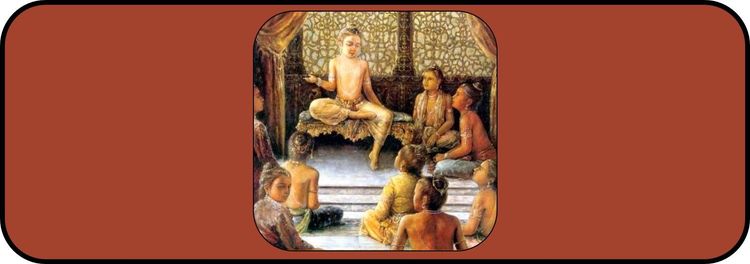
Even though I dint have a clue how exactly to go about teaching them, I felt inspired to somehow start and depend on Krsna. We gathered bunch of neighborhood devotee children around the same age (5-6 yrs) and started having a weekly “Kids Bhagavatam” session.
During the process, Krsna inspired me to write short poems encapsulating the philosophical concepts. This was the turning point. These poems not only helped the kids retain the concepts but also inspired them to inquire further into the subject matter. For example, after discussing the concept of nitya-baddha and nitya-mukta, my younger son Maharathi one day asked, “Amma, what does it mean to be bound”?
These regular Bhagavatam sessions, are also helping them to assimilate the essence of our philosophy into their lives. For instance, while dressing my older son, Nrsimha to school, one day he started saying, “When I go to Krsna..”. Puzzled, I asked, “What do you mean you go to Krsna”? He said, “When I clean my heart before dying, I will go back to Krsna and then …”. Other day while all of us were going to the Dussehra festival, another kid, Ovi, six year old, who attends the sessions was riding along with us. She asked, “Mathaji, you were teaching us the difference between materialistic men and pure devotees, and now we are also going to enjoy, so is this wrong”. I clarified to her how enjoyment with Krsna in the center is not harmful to us.
By Krsna’s mercy, now it is very clear how to teach Srimad Bhagavatam in a systematic way to small kids of age 5 – 6 yrs.
In our weekly sessions, we start with the visual summary of the chapter covered thus far, while kids sing the related poems they learnt. Then we cover the specific set of verses for that week in depth with illustrations, learn related poems, discuss practical examples and have interactive discussions. We then discuss a pastime from our scriptures that exemplifies the concepts discussed and we end with a mock drama enacting the pastime. For example when we discussed SB 1.1.15, where the sages mention that pure devotees can purify one very quickly, we discussed how Narada muni received mercy from the Bhakti-vedantas and became perfect and enacted the drama.
Now I can see that all the kids have developed genuine taste for the subject matter and look forward for the sessions as they have “Krsna conscious fun” with their friends.
To share with devotees worldwide, we have been compiling summary videos of Srimad Bhagavatam chapters, which you can view below. These video helps other kids of similar age to learn the chapter summaries as well as the poems. It will also be useful for older children and adults who want to teach the same to their kids.
We pray these inspire some of you to try this teaching methodology with your kids at home/Sunday school etc. We seek your blessings to continue this journey of learning Srimad Bhagavatam.
Note: You do not need to wait until your child turns five to use these resources. As younger children primarily learn via hearing, we can play audio of the summary/continuously play the poems, and without extra endeavor, they will learn and develop taste for the amala purana – Srimad Bhagavatam.
Your servant,
Śyāmalā dāsī (IDS) (Oct 24th, 2018)
Related poems from previous chapters
Three types of actions
SB_1.2.13-13_Three_types_of_actions.mp3
SB Canto 1, Chapter 8, Songs
Prayers of Queen Kunti
SB_1.8.18-43_Prayers_of_Queen_Kunti.mp3
All attractive Sri Krsna
SB_1.8.46-52_Yudhisthira_maharajas_sadness.mp3
Related Articles
Continue your spiritual journey with these related articles